Vision-Language-Action Models: The Next Frontier of Robotics Careers

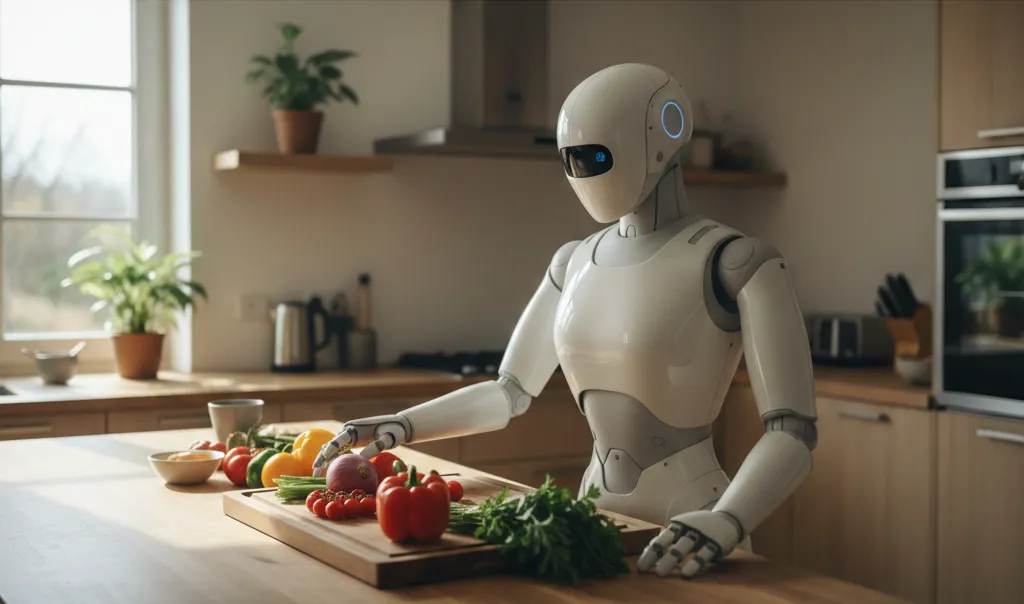
The salary split tells the story—robotics software engineers with AI focus saw salaries surge 51.7% in one year, making it the fastest-growing AI job category. Traditional robotics engineers? Their salaries declined 10.9%. This divergence signals where the industry is heading: toward AI-driven robots that can see, understand language, and act.
What’s driving this shift is a new type of AI called Vision-Language-Action models. Unlike traditional robotics that separates perception, planning, and control into distinct modules, VLA models process everything end-to-end through a single neural network. A robot sees an object, understands a spoken instruction, and generates movement—all without hand-coded rules.
For engineers, this represents a career inflection point—especially for those targeting Machine Learning Engineer Jobs. The companies building these models raised over $2 billion in 2025 alone. Figure AI’s valuation jumped from $2.6B to $39B in a single round. Physical Intelligence secured $600M in Series B funding. The job market is signaling demand too: employers from Amazon to Meta are actively hiring for VLA-related skills, and our analysis shows this demand spans 71 different companies.
This article explains what VLA models are, why they matter for your career, which skills employers want, and how to position yourself for opportunities in this emerging field.
What Is a Vision-Language-Action Model?
A Vision-Language-Action model unifies three capabilities that traditional robotics treats separately: visual perception, language understanding, and robot control. According to a recent survey on arXiv, “Vision-Language-Action (VLA) models represent an emerging paradigm in embodied AI that unifies visual perception, linguistic understanding, and action generation within a single neural architecture.”
Video: LLMs Meet Robotics: What Are Vision-Language-Action Models? (VLA Series Ep.1)
The distinction matters. Traditional robotics pipelines process images (vision), decode commands (language), and execute movements (action) as independent steps. Each stage requires specialized code, carefully tuned parameters, and frequent manual intervention. VLA models handle all three together—learning directly from demonstrations rather than explicit programming.
This end-to-end approach enables robots to generalize to new tasks without code changes. A traditional pick-and-place system needs separate programs for each object type and orientation. A VLA-powered robot can understand “pick up the red cup” and figure out the approach on its own, even if it hasn’t seen that exact cup before.
The demand signal is real. Our job tracking shows employers ranging from tech giants like Amazon and NVIDIA to robotics specialists like Skydio and Bosch actively hiring for these skills. This isn’t theoretical research—companies are deploying VLA-powered robots in warehouses, factories, and retail stores today.
How VLA Models Work: Architecture Explained
The technical architecture of VLA models builds on familiar concepts from machine learning, but combines them in ways specific to robotics. Using OpenVLA as a reference example, a typical VLA consists of three main components: a fused visual encoder, a projection layer, and a language model.
The visual encoder processes camera input through architectures like SigLIP and DinoV2—backbones proven effective for image understanding. A multi-layer projector aligns these visual features with the language model’s embedding space. The language model itself (often Llama-2-7b or similar) then generates actions as tokens, similar to how it would generate text. Finally, a de-tokenizer converts these action tokens into robot commands.
Why this architecture matters: it lets robotics engineers leverage the entire LLM ecosystem. Training techniques, infrastructure, and optimization tools developed for text models transfer directly to robot control. The difference is what the model outputs—joint angles, gripper commands, or trajectory points instead of words.
Models like OpenVLA train on the Open-X-Embodiment dataset, which aggregates over 970,000 robot demonstrations across different platforms. This cross-robot data is what enables generalization, though current limitations mean performance varies significantly across robot types and environments.
VLA vs. Traditional Robotics Pipelines
| Aspect | VLA Models | Traditional Pipeline |
|---|---|---|
| Execution Speed | ~0.19s | ~9.4s |
| Architecture | Unified neural network | Modular (separate perception/planning/control) |
| Generalization | Data-driven—learns from examples | Rule-based—requires explicit programming |
| Reasoning | Limited long-horizon planning | Strong multi-step planning |
| Cross-embodiment | Poor—struggles across robot types | Framework-agnostic |
Source: Esperanto Robotics analysis
What this comparison shows: VLA models excel at fast execution and adapting to new tasks through data. Traditional approaches remain superior for complex reasoning and extended planning. Most production systems use hybrid approaches—VLA handles perception and immediate reactions, while classical planning manages longer sequences.
For engineers, this means understanding both paradigms. Pure VLA systems struggle with multi-step tasks. Pure classical systems are slow to adapt. The valuable skill is knowing when to apply each approach—or how to combine them effectively.
Who’s Building VLA Models? Key Players and Real-World Deployments
The funding wave validates that VLA technology has moved beyond research labs. Figure AI’s Series C drove valuation from $2.6B to $39B. Physical Intelligence raised $600M in Series B funding, doubling valuation to $5.6B. In 2025 alone, nine companies completed 13 financings exceeding $100M each in embodied intelligence, according to 36Kr’s funding analysis.
The key players fall into several categories:
Model Builders: Figure AI develops the Helix VLA with a “fast-slow brain” architecture for balancing quick reactions with deliberation. Physical Intelligence open-sourced their π0 and π0.5 models, regarded as among the strongest publicly available. XPeng announced VLA 2.0 for automotive and humanoid applications. Google DeepMind’s RT-2 builds on their Robotic Transformer line with vision-language model integration.
Open Source: OpenVLA provides a 7B-parameter model with training code and documentation for community development.
Real deployments are already happening. Telexistence’s Astra humanoid robot stocks shelves at Seven-Eleven stores in Japan, understanding spoken instructions and adapting to different store layouts. Preferred Networks and Toyota combine VLA models with advanced sensors for assembly line robots that adjust on the fly. Japan’s automotive industry installed approximately 13,000 industrial robots in 2024, an 11% year-over-year increase, with VLA capabilities increasingly factoring into purchasing decisions according to industry analysis.
What this means for careers: these companies aren’t just hiring for core model development. They need robotics engineers to integrate VLA models into existing systems, validate safety in real-world environments, collect training data at scale, and deploy in production. The jobs span integration, deployment, infrastructure, and applications—not just “VLA researcher” roles.
What VLA Models Can’t Do Yet: Current Limitations
Understanding the limitations of current VLA technology is as important as understanding the capabilities. These constraints aren’t just technical challenges—they represent career opportunities for engineers who solve them.
Data scarcity is the primary bottleneck. As noted in the arXiv survey, “The primary bottleneck in VLA development is the scarcity of high-quality robot demonstration data.” Unlike large language models trained on internet text, VLA models need physical robot demonstrations—collected either in the real world or through high-fidelity simulation. Japan is investing heavily in robot data collection infrastructure, but obtaining “huge amounts of real-world action data” remains difficult and expensive.
Long-horizon reasoning is another gap. Current VLA models train on relatively short action sequences and struggle with extended tasks requiring multi-step planning. Ask a VLA-powered robot to “clean the kitchen,” and it might excel at individual actions—wiping surfaces, loading dishes, moving items—but fail to coordinate the overall sequence efficiently. The survey notes “limited capability for long-horizon reasoning and multi-step planning” as a key constraint.
Cross-embodiment generalization remains unreliable. Models trained on one robot often fail on robots with different morphologies or sensor configurations. A model trained on a 7-degree-of-freedom arm may not transfer to a humanoid without substantial retraining. This limits reusability across projects.
The lack of predictable scaling laws compounds these challenges. Unlike LLMs where “more data + compute = better performance” follows relatively predictable curves, VLA models haven’t demonstrated clear scaling behavior. According to 36Kr’s analysis, “The industry has not witnessed a Scaling Law like that of large-language models,” making it harder to justify massive infrastructure investments.
These constraints create specific career opportunities:
- Data engineering for robotics: Collecting, curating, and simulating robot demonstrations
- Sim-to-real transfer: Bridging the gap between simulation training and deployment
- Long-horizon planning: Integrating VLA with classical planning architectures
- Cross-embodiment learning: Building more generalizable models
Engineers who specialize in solving these problems will find themselves in high demand as the field matures.
Skills Required for VLA Engineering Roles
Building a career around VLA models requires combining robotics fundamentals with modern machine learning skills. The specific breakdown depends on your background, but certain foundations are non-negotiable.
Core Programming Foundations
Python and C++ proficiency appears in 85% of robotics engineering job postings, according to SkillsU analysis. Both Python Jobs and C++ Jobs remain in high demand as foundational languages for robotics development. Python is the de facto language for ML research and prototyping. C++ is essential for performance-critical robotics applications and real-time control loops. ROS/ROS2 serves as the standard middleware for integrating with robot hardware.
Machine Learning & AI
PyTorch or TensorFlow is required—PyTorch is preferred in most research settings. Computer vision fundamentals (OpenCV, camera calibration, image processing) are essential for the “vision” component, making Computer Vision Jobs closely aligned with VLA development work. Understanding transformer architectures and attention mechanisms matters for working with modern VLA architectures. Training techniques like behavior cloning, imitation learning, and basic reinforcement learning provide the foundation for learning from demonstrations.
Robotics Fundamentals
Kinematics and dynamics—forward and inverse kinematics, motion planning—understand how robots move. Control systems knowledge (PID, trajectory planning, hardware constraints) is critical for converting model outputs into smooth, safe robot motion. Sensor integration experience with cameras, depth sensors, IMUs, and lidar connects models to the physical world. Simulation tools like Gazebo, Isaac Sim, or PyBullet let you test without hardware access.
VLA-Specific Skills (Emerging)
Vision-language models like CLIP or BLIP provide context for the multimodal architecture. Understanding action representation—whether discrete tokens or continuous control spaces—affects how models generate robot commands. Fine-tuning techniques (LoRA, partial fine-tuning, full fine-tuning) matter for adapting pre-trained models to specific tasks. Multi-modal fusion—how vision, language, and action representations combine—is the core technical challenge.
Mathematics Foundation
Linear algebra (matrices, transformations, eigendecomposition), calculus (gradients, optimization for training), and probability/statistics (handling sensor uncertainty, stochastic processes) provide the theoretical grounding.
Learning Path Priority
If starting from scratch: Python → ML basics → PyTorch/TensorFlow → Computer Vision → ROS → Robotics fundamentals → VLA-specific projects. Our Robotics Skills Map provides a visual overview of how these competencies connect across different career paths.
If already in robotics: Add ML/AI skills—PyTorch, computer vision, then experiment with OpenVLA.
If already in ML/Computer Vision: Add robotics fundamentals—ROS, kinematics, control systems, simulation.
VLA Career Paths and Job Roles
“VLA Engineer” doesn’t exist as a job title yet—the field is too new. The roles exist, but they’re disguised under more traditional headings. Knowing what to search for is half the battle.
Job Titles to Target
Look for these titles at companies working on VLA technology: Machine Learning Engineer - Robotics, AI Engineer - Robotics, Vision Engineer, Robotics Software Engineer (with ML/AI requirements), Perception Engineer, and Foundation Model Engineer (at companies like Figure AI and Physical Intelligence).
Typical Career Progression
Entry-Level (0-2 years): Robotics Software Engineer, ML Engineer Junior. Salary ranges from $85,000-$100,000 according to SkillsU data. For comprehensive salary context across experience levels, our Salary guide provides detailed breakdowns. Focus areas include implementation, data collection, and model integration.
Mid-Level (3-5 years): ML Engineer, Robotics Engineer II, Perception Engineer. Salary ranges from $140,000-$170,000 based on AI engineer salary data. Focus shifts to model development, fine-tuning, and deployment.
Senior (5+ years): Staff ML Engineer, Lead Robotics Engineer, Principal AI Engineer. Salaries reach $170,000-$210,000+ depending on company and location. At Torc Robotics, machine learning engineers earn a median of $174,000 with top compensation reaching $225,600, according to Levels.fyi data. Focus encompasses architecture, research leadership, and technical strategy.
Company Types Hiring
VLA Model Builders: Figure AI, Physical Intelligence, XPeng, Google DeepMind, Tesla. These roles focus on core model development and research engineering. Robotics Engineer Jobs at these companies emphasize VLA expertise.
Robotics Companies Integrating VLA: Amazon Robotics, Waymo, Skydio, Bosch, GM, Samsung Research. Roles emphasize integration, deployment, and infrastructure.
Industrial Automation: Companies deploying warehouse and manufacturing automation. Positions often focus on application engineering and customer solutions.
Research Labs: Meta AI, academic institutions, corporate R&D. Work tends to be research engineering with publication-focused development.
Industry Growth Context
The broader robotics industry is projected to grow at 25% CAGR from 2023 to 2030, expanding from approximately $50B to $200B+, according to SkillsU industry analysis. AI-focused roles are driving much of this expansion. The composition of roles suggests a field with advancement opportunities—entry-level positions comprise roughly 30% of roles, while senior and managerial positions account for approximately 50%.
Searching recommended jobs...
VLA is an emerging field. Job titles don’t reflect “VLA Engineer” yet. Look for Machine Learning Engineer, Robotics Software Engineer, or Perception Engineer roles at companies like Figure AI, Physical Intelligence, XPeng, and Google DeepMind.
Companies Hiring for VLA-Related Skills
The employer landscape spans tech giants, robotics specialists, and automotive companies. Each type offers different work environments and career trajectories.
Amazon leads with the highest volume of positions requiring VLA-related skills, reflecting heavy investment in warehouse automation and robotics R&D. The work spans from research prototyping to large-scale deployment across fulfillment centers.
Tech AI giants like Meta and NVIDIA are hiring for VLA skills to build next-generation AI systems. These roles often pay at the top of industry ranges—NVIDIA machine learning engineers average approximately $270,000 based on public compensation data. The work tends to be more research-oriented with longer time horizons.
Automotive and transportation companies including GM, Waymo, XPeng, and Qualcomm apply VLA technology to autonomous driving and vehicle automation. These roles combine traditional robotics safety requirements with cutting-edge AI. The work is highly regulated but has clear commercial impact.
Robotics specialists like Skydio, Applied Intuition, and Bedrock Robotics build VLA-powered products for specific markets—drones, trucking, industrial automation. These companies offer focused product development experience with faster feedback loops between engineering and deployment.
How to approach these opportunities: Don’t just submit applications. Build relevant evidence first. Fine-tune OpenVLA on a manipulation task in simulation. Deploy a VLA model on a real robot and document the challenges. Contribute to open-source robotics projects. The employers hiring for these skills care about demonstrated ability to work with vision-language-action systems—proof matters more than coursework.
How to Learn VLA Skills: A Practical Roadmap
Dedicated VLA courses don’t exist yet. Learning is self-directed through open-source projects and general ML/robotics education. This represents an opportunity—early movers differentiate themselves by demonstrating initiative.
The Learning Path by Background
If you’re new to both robotics and ML:
- Foundations (3-6 months): Python programming, linear algebra, calculus
- ML Basics (3-6 months): PyTorch/TensorFlow, neural networks, supervised learning
- Computer Vision (2-3 months): Image processing, OpenCV, CNNs
- Robotics (3-6 months): ROS basics, kinematics, control systems
- VLA Projects: Experiment with OpenVLA, replicate research papers
If you’re a software engineer transitioning in:
- ML Fundamentals (2-3 months): PyTorch, deep learning, transfer learning
- Computer Vision (2 months): Vision transformers, CLIP-style models
- ROS (1-2 months): Basic robot operation and simulation
- VLA Hands-On: Start with OpenVLA tutorials, experiment with fine-tuning
If you’re already in robotics:
- ML/DL Skills (3-4 months): PyTorch, vision transformers, training techniques
- VLA-Specific: Study OpenVLA architecture, experiment with fine-tuning
- Projects: Adapt VLA models to your robot platform or domain
Key Resources
Open-Source Projects: OpenVLA on GitHub provides installation, fine-tuning documentation, and pretrained models. Physical Intelligence’s π0 and π0.5 models are open-sourced and regarded as benchmarks.
Structured Learning: Microsoft’s AI Engineer career path offers self-paced and instructor-led training for general ML/AI fundamentals. Various robotics certifications cover coding, ML basics, and hands-on practice.
Practice Strategy
- Start with OpenVLA inference tutorials to understand the pipeline
- Fine-tune on a simple manipulation task in simulation
- Integrate with ROS for robot control
- Document and share projects on GitHub
Building Portfolio Evidence
Employers can’t evaluate “VLA skills” directly—they look for proxies. What matters: GitHub projects demonstrating VLA model usage, fine-tuning experiments with documented results, contributions to open-source robotics projects, and blog posts or technical writing about VLA topics. A portfolio showing you can work with these systems carries more weight than coursework.
Common Questions About VLA Models and Robotics Careers
How do VLA models work?
Is VLA imitation learning?
Does AI fall under robotics?
The Future of VLA Models and Your Career
The financing activity of 2025 suggests embodied intelligence is following a similar trajectory to large language models—just two to three years behind. Nine companies raised rounds exceeding $100M. Figure AI’s valuation jumped 15x in one funding round. This capital must be deployed into hiring and development.
Near-term (1-3 years): Hybrid systems dominate. VLA models handle perception and short-horizon actions, while traditional planning manages longer sequences. Engineers who understand both paradigms will be most valuable. The job titles will remain “Robotics Software Engineer” and “ML Engineer,” but the day-to-day work will increasingly involve VLA integration.
Medium-term (3-5 years): If scaling laws emerge and data bottlenecks ease, we could see more general-purpose robot capabilities. This is where the largest career upside exists—but also the most uncertainty. The engineers working on VLA models now will be the senior specialists when the technology reaches mainstream adoption.
Career positioning: Don’t wait for the field to mature. The engineers who enter now gain early-mover advantage as the technology scales. Start with foundational skills, experiment with open-source models, and position yourself at the intersection of robotics and AI. The salary divergence we’re already seeing—up 51.7% for AI-focused robotics engineers, down 10.9% for traditional roles—suggests the market is rewarding this positioning today.
The path forward isn’t about predicting exactly how VLA technology will evolve. It’s about building skills that remain valuable regardless of which architectures win: robotics fundamentals, machine learning expertise, and hands-on experience with multimodal systems. Those skills transfer across companies, applications, and technology cycles.
Share this guide on
Article by

Robotics Platform Engineer at Menlo Research (menlo.ai) and founder of CareersInRobotics.com, where he analyzes thousands of robotics job postings to identify salary trends, skill demands, and hiring patterns.