Top Robotics Hubs in Europe

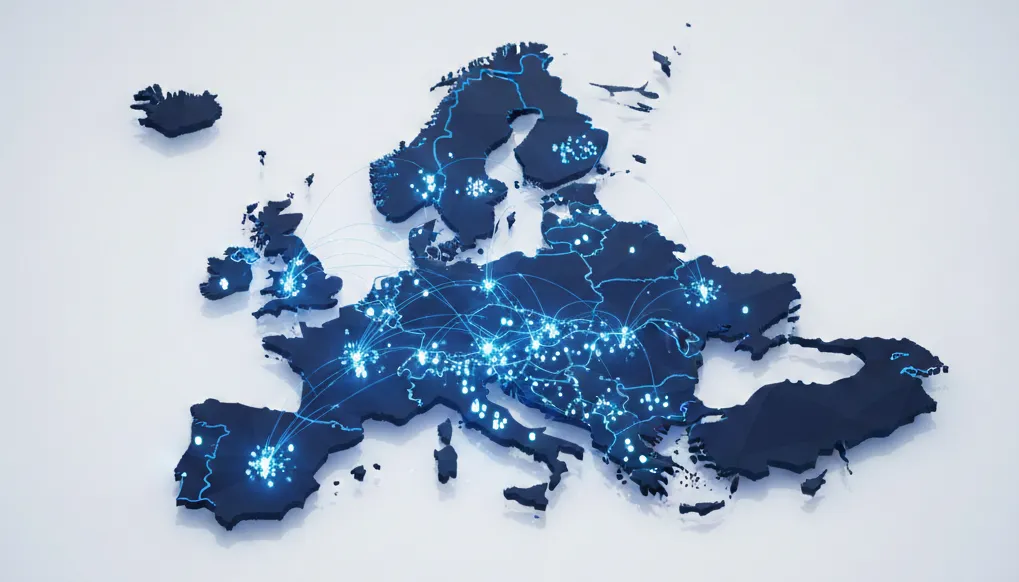
Europe’s robotics opportunities aren’t evenly distributed. They’re concentrated in distinct hubs, each with different specializations, salary structures, and barriers to entry. The “best” hub depends on your role type—software versus hardware versus research—your language abilities, and your career priorities. Not which country has the most job openings.
The European robotics market is substantial and growing: €20 billion in 2025, projected to reach nearly €30 billion by 2029. The region’s intensity is higher than the global average—219 industrial robots per 10,000 workers compared to approximately 151 worldwide. Germany leads with 429 robots per 10,000 employees, ranking fourth globally. The European Union is backing this momentum with €174 million in R&D funding through 2025.
What follows is a career-focused comparison of Europe’s major automation hubs, based on our analysis of 493 active positions across 11 countries as of February 2026.
Comparison of Top European Robotics Hubs
| Hub | Language Barrier | Primary Specialization | Best For |
|---|---|---|---|
| Germany | High (German required) | Industrial automation, hardware | Controls engineers, manufacturing automation |
| United Kingdom | Low (English-speaking) | Field service, defense systems | Field service engineers, technicians, English speakers |
| Switzerland | Low (English-friendly) | Deep tech, research | Research engineers, PhDs, mobile robotics |
| Denmark | Low (English-friendly) | Collaborative robots, AMRs | Cobot specialists, AMR careers, startup ecosystem |
| France | Medium (French helpful) | AI-robotics convergence | AI-robotics intersection, aerospace applications |
| Netherlands | Low (English-friendly) | Agricultural robotics | Research careers, agricultural robotics |
| Nordics | Low (English-friendly) | Maritime, forestry | Specialized applications (maritime, forestry) |
Germany: Europe’s Industrial Powerhouse
Germany dominates European automation with the largest market and highest density. This is where hardware and industrial systems thrive. Munich and Stuttgart form the core industrial cluster anchored by major players like KUKA, NEURA Robotics, and BMW.
Our analysis shows 109 active positions in Germany, though language requirements filter out many German-language roles from our database.
German language is a real barrier. 69 German job postings in our database explicitly require German proficiency. This isn’t a soft preference—it’s a hard requirement for many roles, especially those involving customer-facing work or collaboration with manufacturing teams that operate primarily in German.
Germany’s strength is industrial automation and manufacturing. The country’s High-Tech Strategy 2025 allocates €350 million specifically to R&D in this sector. When Michael Rathmair of JOANNEUM RESEARCH reflected on the European Robotics Forum 2025 in Stuttgart, he noted that trends like “AI-driven Robotics, Human-Robot Collaboration, Sim-to-Real Transfer, Sustainable Automation, Tactile Sensing and Autonomous Systems” shaped the program—emphases that align with Germany’s industrial base.
Best for: Controls engineers, manufacturing automation specialists, industrial hardware roles.
Language reality: German required for many positions. English-only postings represent a fraction of the total market.
Searching recommended jobs...
United Kingdom: Field Service and Applied Automation
The United Kingdom has the most openings in Europe—157 active positions in our database—but with a notable specialization difference. The UK emphasizes practical, field-deployed systems: defense, field service, and real-world applications rather than pure research.
The role types differ significantly from continental Europe: UK postings emphasize technician and field service roles, while Germany shows more concentration in ML and software engineering positions.
Top employers in the UK dataset include Boston Dynamics (21 positions), Wayve (15), and Amazon (13). The industries hiring most heavily are Aerospace & Defense (57 positions), Software & AI (52), and Energy & Mining (44). The most common roles are Automation & Robotics Technician (62 positions) and Field Service Engineer (39).
London, Bristol, and Edinburgh are the key clusters. Bristol Robotics Laboratory describes itself as “the most comprehensive academic centre for multi-disciplinary research in the UK,” and Edinburgh’s National Robotarium opened in 2022 as a dedicated automation and AI facility. The UK offers the clearest path for English speakers—no language barrier for domestic relocation. For United Kingdom jobs, explore our listings. European candidates should note that Brexit has changed work authorization requirements.
Best for: Field service engineers, defense and autonomous systems work, technicians, English-speaking candidates.
Searching recommended jobs...
Switzerland: High Salaries, High Costs
Zurich and Geneva (EPFL) form Switzerland’s deep-tech powerhouse. This is research-heavy territory with elite institutions feeding talent into autonomous systems startups.
Zurich software engineers average approximately $94,500 annually—the highest in Europe. But Zurich also ranks as Europe’s most expensive city. The tradeoff is real: you’ll earn more, but housing, food, and transportation consume a larger share of that income. For software engineers splitting time between home and office, Zurich is considered “cheaper” relative to earnings than nominal comparisons suggest—but it’s still expensive.
What Switzerland lacks in market scale it makes up for in depth. Swiss deep tech startups have a combined value exceeding $100 billion, with roughly 60% of Swiss venture capital flowing to deep tech rather than software or consumer products. Major companies include ANYbotics (legged robots), Swiss-Mile (mobile manipulation), and a growing ecosystem of autonomous vehicle startups.
The research pipeline is elite. ETH Zurich hosts IRIS with 10 independent automation labs, while EPFL maintains 12 core plus 13 affiliated labs and hosted RoboSoft 2025. These institutions produce PhDs and research scientists who feed directly into local startups.
Best for: Research-oriented roles, autonomous systems, deep tech careers, candidates with advanced degrees.
Cost reality: Highest salaries in Europe, but highest living costs. Factor in housing and taxes before comparing nominally.
Denmark: The Cobot Capital
Odense, not Copenhagen, is Denmark’s automation center. The city transformed itself into the world’s collaborative robot hub through a deliberate cluster strategy anchored by Universal Robots (cobots) and Mobile Industrial Robots (MiR, now part of Teradyne).
Universal Robots reached 1,000 employees in 2022—a milestone that signaled cobot technology’s move from niche to mainstream. In May 2024, Universal Robots and MiR opened a joint hub in Odense, consolidating their presence in Denmark’s third-largest city. The broader Odense cluster now includes 85+ companies, with Denmark’s automation sector forecast to employ 23,000 people by 2025.
What makes Denmark distinctive is the collaboration culture between industry and research institutions. Companies actively partner with the University of Southern Denmark and the Danish Technological Institute. The ecosystem emphasizes practical commercial applications of collaborative robots—systems designed to work alongside humans in manufacturing, logistics, and healthcare settings.
English is widely spoken in Danish robotics companies, especially in technical roles. However, Danish becomes important for long-term career progression and integration into Danish work culture, which places high value on flat hierarchies and consensus decision-making.
Best for: Collaborative robotics careers, autonomous mobile robots, candidates interested in startup ecosystems with strong industrial backing.
Emerging Hubs: France, Netherlands, Nordics
Beyond the big four, secondary hubs offer focused specializations. Paris and Toulouse anchor France’s scene, with VivaTech 2025 featuring 36 companies demonstrating AI-powered convergence. France’s services sector includes 52 companies with 13 having raised funding totaling $6.54 million. Toulouse’s aerospace legacy feeds into autonomous systems applications for aviation and defense.
Notable French companies include Wyca (mobile autonomous systems for logistics), Exotec (warehouse automation which raised $335 million in Series D funding), and Rabbit (autonomous mobile platforms for retail). The Paris region hosts EBV (electronic component distribution) and various AI-automation startups emerging from Station F, the world’s largest startup campus.
The Netherlands centers on Delft, where TU Delft’s institute describes itself as “a center of a thriving ecosystem” and hosted RSS 2024—a major international conference. Agricultural automation is a particular strength given the Netherlands’ intensive greenhouse agriculture sector. Wageningen University & Research collaborates closely with companies on autonomous farming applications.
Dutch agricultural automation companies include Picnic (automated grocery delivery), Smart Robotics (autonomous picking systems), and MIREA (greenhouse automation). The Amsterdam region also hosts TechMedic (medical systems) and Collabtrix (human-automation collaboration systems). The Dutch government’s “AI for Good” initiative explicitly funds agricultural and medical applications, creating public-private research opportunities.
The Nordics offer specialized ecosystems: Sweden for forestry automation (Deep Forestry, Everdrone, Airforestry), Norway for maritime and offshore applications, and Denmark (already covered) for cobots and AMRs. Sweden’s KTH Royal Institute of Technology is a top European education destination, while Norway’s offshore sector creates demand for autonomous ships and underwater systems.
Notable Nordic companies include Sweden’s Abyss (autonomous underwater vehicles), Norway’s Hystar (hydrogen technology for automation) and Maritime Robotics (autonomous surface vessels), and Finland’s Kalmar (automated port handling equipment, part of Cargotec). Finland also hosts VTT Technical Research Centre, which operates one of Europe’s largest research programs with particular strength in heavy-duty automation for forestry and ports.
These smaller hubs offer fewer openings but more focused specialization. They’re worth targeting if your expertise aligns with their niche—agricultural automation in the Netherlands, maritime tech in Norway, or forestry tech in Sweden.
Best for: AI-robotics intersection work (France), research careers (Netherlands), niche specializations (Nordics by sector).
Choosing the Right Hub for Your Role
Not all hubs are equal for all automation disciplines. Match your role type to the ecosystem that emphasizes it.
Software and ML engineers: Germany (Munich and Berlin), Switzerland (Zurich), and the UK (London) have the highest concentration of software-first positions. Germany’s job postings skew toward ML engineers and software engineering roles, while the UK offers more field service and technician positions.
Hardware and controls engineers: Germany’s industrial base makes Munich and Stuttgart the clear choice. The machinery and manufacturing sectors demand embedded systems engineers, controls engineers, and mechatronics specialists. The UK’s Bristol cluster also offers hardware roles, particularly in defense and aerospace applications.
Field service and technicians: The UK dominates here with 62 Automation & Robotics Technician positions and 39 Field Service Engineer roles in our database. Germany also offers field service positions but with stricter language requirements. These roles involve deploying and maintaining systems at customer sites—manufacturing floors, warehouses, energy facilities.
Research and PhD roles: Switzerland (ETH Zurich, EPFL), Denmark (SDU, Odense Robotics), and the Netherlands (TU Delft) offer the strongest research ecosystems. These institutions maintain close industry ties, so research often transitions into commercial applications. UK research institutions (Bristol, Edinburgh) are also strong but with more applied focus.
Startup careers: Switzerland’s deep tech startups, Denmark’s cobot cluster, and London’s broader tech ecosystem offer the most startup options. Understanding the most in-demand roles can help target the right opportunities. Switzerland’s startups tend to be spinouts from university research, while Denmark’s often grow within the Odense Robotics support network.
Language consideration: English suffices for many roles in the UK, Switzerland, Netherlands, and Nordics. Germany requires German for many positions, especially those involving manufacturing teams or customer-facing work. French becomes increasingly important for senior roles in France.
For students planning where to study: University choice in Europe creates direct pipeline access to regional ecosystems. See our Student Career Guide for more on education paths. ETH Zurich and EPFL place graduates directly into Swiss deep tech startups like ANYbotics and Swiss-Mile. TU Delft feeds the Dutch agricultural sector. Denmark’s University of Southern Denmark (SDU) maintains close ties with Universal Robots and the Odense cluster. KTH Royal Institute of Technology in Sweden connects to the forestry ecosystem. Germany’s Technical University of Munich (TUM) and Karlsruhe Institute of Technology (KIT) feed BMW, KUKA, and the broader industrial sector. For Germany jobs, see our dedicated listings.
Salary Reality Check: Cost of Living Matters
Nominal salaries don’t tell the full story. After adjusting for cost of living, the ranking changes dramatically.
Cost-of-Living Adjusted Earnings (Software Engineers)
| Rank | City | Net Savings Potential | Key Factor |
|---|---|---|---|
| 1 | Munich | Best | 28% lower costs than Amsterdam, similar salaries |
| 2 | Amsterdam | Strong | High gross salaries, but higher costs than Munich |
| 3 | Zurich | Good | Highest salaries offset by highest living costs |
| 4 | London | Weakest | High rents and transport consume nominal advantage |
Our proprietary data shows a striking difference: Germany’s median salary of $118,005 is approximately 51% higher than the UK’s $78,000 median. However, our German dataset is smaller (n=10 vs n=72 UK) and skewed toward senior and specialized roles. External benchmarks show more mixed figures—Germany’s overall engineering average is around €65,000-€85,000 for typical robotics positions, with IG Metall-covered industrial roles often lower than our sample suggests.
Cost-of-living adjusted rankings for software engineers tell a different story: Munich ranks first for net earnings, Amsterdam second, Zurich third, and London last despite high nominal salaries. Munich offers 28% lower cost of living than Amsterdam with similar tax rates (~41%), making high salaries stretch further. London’s high rents and transportation costs consume much of the nominal advantage.
Zurich illustrates the tension clearly: highest salaries in Europe, but also the highest living costs. For software engineers, Zurich is “cheaper” relative to earnings—but that still means paying premium prices for housing, food, and entertainment. The tradeoff only makes sense if your role leverages Zurich’s unique strengths: elite research institutions, deep tech startups, and proximity to European headquarters of major tech companies.
Practical guidance: Early-career professionals should prioritize skill development and network access over short-term earnings. A lower salary in Munich might afford better savings than a higher salary in London or Zurich. Mid-career professionals with specialized skills can target Switzerland for the salary premium—but negotiate with full awareness of housing costs.
Housing warning: Amsterdam and Berlin face acute housing shortages in 2026. Finding an apartment can be harder than finding a job in these cities. Secure housing before resigning from your current position, and factor in several months of search time for competitive markets like these.
Practical Considerations for Relocation
Beyond salaries and job openings, consider language requirements, work culture, and relocation support.
Language: English is a prerequisite for most engineering roles across Europe. However, local language proficiency on your CV “will more likely attract eyes”—in Germany especially, where German language skills are valued across the DACH region even for positions that don’t explicitly require it. The European Space Agency lists English and French as working languages and values knowledge of other EU member state languages.
Relocation support: Some companies have developed three-step programs specifically to help US talent relocate, ranging from visa paperwork assistance to housing search help. While remote work exists in automation, hardware roles typically require on-site presence. Hardware roles are more likely to include relocation support than software-only positions because the work demands frequent in-person collaboration and direct hardware access.
Work culture: France’s automation engineers expect clear direction while valuing professional independence and work-life balance. German work culture is more structured with clear hierarchies and processes. The UK’s culture is closest to US norms but with more statutory vacation and stronger employee protections. Swiss culture combines German precision with international openness in tech companies.
Visa processes: The EU Blue Card is available for qualified non-EU citizens with a job offer meeting salary thresholds. Germany’s Opportunity Card (Chancenkarte), introduced in 2024, allows qualified non-EU citizens to enter Germany for up to one year to search for work—useful for candidates who want to secure employment before relocating. UK work authorization has become more restrictive post-Brexit. Switzerland maintains its own visa system separate from the EU.
Integration: Learning the local language pays long-term dividends even if your role is initially English-speaking. It expands your internal job mobility, improves collaboration with local colleagues, and strengthens your position during reorganizations or management transitions.
Common Questions About European Automation Hubs
Which European hub pays the most for robotics engineers?
Do I need to speak German to work in robotics in Germany?
Is English enough for robotics jobs in Europe?
Which European city is best for robotics careers?
What is the cost of living difference between European robotics hubs?
Conclusion
Europe’s automation landscape is hub-specific, not uniform across countries. Germany offers the strongest industrial opportunities but requires language commitment. The UK provides the most openings with the clearest path for English speakers, especially in field service and applied systems. Switzerland delivers the highest salaries for research-oriented roles, with Denmark offering a focused collaborative ecosystem.
The right hub depends on your role type, language abilities, and career priorities. Software engineers might target Munich, Berlin, or Zurich. Hardware specialists should look to Germany’s industrial base. Field service careers thrive in the UK. Research roles cluster around ETH Zurich, EPFL, and TU Delft.
Look beyond nominal salary to cost-of-living adjusted earnings. Factor language requirements into your realistic job market size. Consider whether relocation support is available—hardware roles are more likely to include it than software-only positions.
Europe’s automation market will reach €30 billion by 2029. The opportunities are substantial, but they’re concentrated in specific cities with distinct specializations. Choose your hub based on where your role type is most valued, not which country has the most total openings.
Share this guide on
Article by

Robotics Platform Engineer at Menlo Research (menlo.ai) and founder of CareersInRobotics.com, where he analyzes thousands of robotics job postings to identify salary trends, skill demands, and hiring patterns.